
September 23, 2026
Pretend play with safe everyday objects
Try simple pretend play with a cup, spoon, cloth, or toy. Follow your toddler's idea, keep objects safe, and record the small actions that emerge.
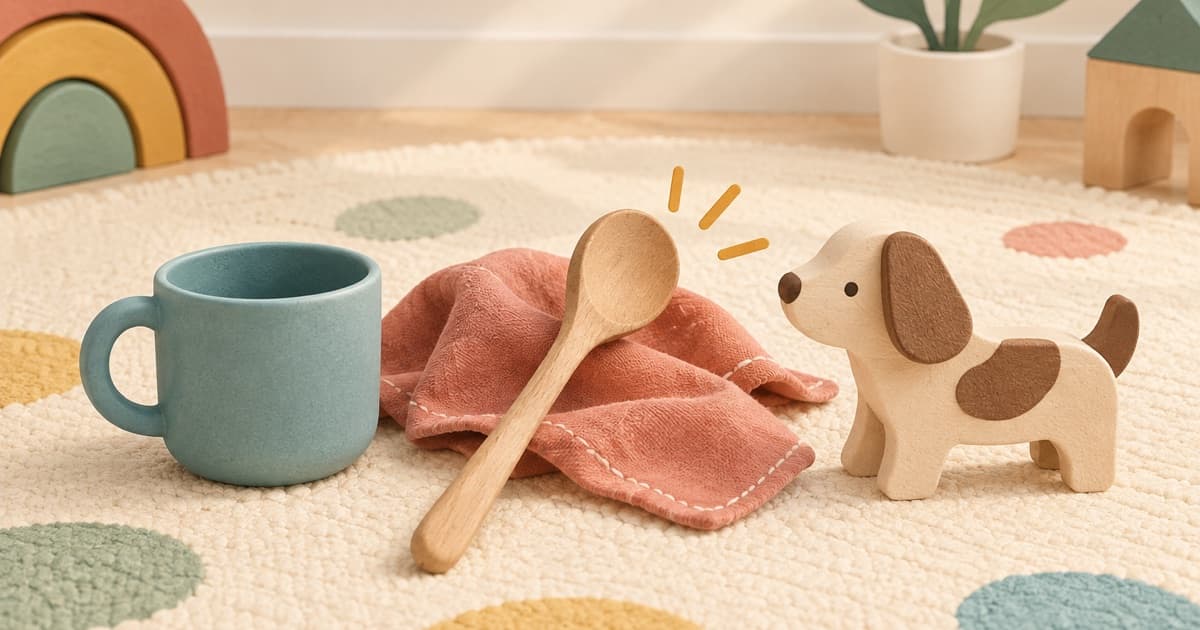
Pretend play can begin with one familiar action: offering an empty cup, rocking a toy, or using a wooden spoon as a microphone. You do not need a themed toy set. Choose a large, safe object, model one action, then pause so your toddler can copy it, change it, or walk away.
Key takeaways
- Start with one familiar object and one short action.
- Copy your toddler's idea instead of directing a finished story.
- Use large, intact objects and stay close throughout play.
- A repeated action or new sound is worth noticing; it is not a test.
| If your toddler watches | Model one action slowly, then wait. |
|---|---|
| If they copy | Name the action: “You are giving the toy a drink.” |
| If they change the idea | Follow their version and add one word or sound. |
| If they leave | End the game without asking for a performance. |
A three-minute setup
- Choose one clean, unbreakable household object with no small or loose parts.
- Add one toy or cloth only if it makes the action clearer.
- Show one pretend action, describe it in a short sentence, and pause.
- Let your toddler repeat, transform, or finish the game.
What you can observe
Notice whether your toddler copies an action, combines two objects, adds a sound, or invites you into the play. CDC examples at 18 months include copying chores; by two years, children may use more than one toy together. These are population examples, not deadlines for one child.
What is useful to record
Write the date, the objects, what your toddler did without help, and any word or gesture they added. “Held the empty cup to the toy dog, then said ‘more’” is more useful than “good imagination.”
A question for your clinician
At a routine visit, you might ask: “What kinds of copying and pretend actions would you expect to see next, given my child's age and history?” Bring two ordinary examples rather than rehearsing a task for the appointment.
Limits of this guide
Pretend play varies with interest, language exposure, fatigue, and familiarity. Tracking helps you remember patterns; it does not diagnose development. Ask a qualified clinician about lost skills, several areas of concern, or anything that worries you.
For a wider view, use the milestone hub and the imitation-games guide. baby milestones by month imitation games with your baby
Sources
Every figure in this guide traces to one of these sources.
- CDC — Milestones in Action: By 18 Months
- CDC — Milestones in Action: By 2 Years
- American Academy of Pediatrics — The Power of Play
- Kementerian Kesehatan RI — Buku KIA 2024
General information, not medical advice. Talk to your pediatrician about your own child.

- Category
- Parenting · Child development
- Type
- Baby milestone & activity companion
- Compatibility
- iPhone (iOS) and Android
- Business model
- Free to start, for little ones 0–24 months
 Press ContactThe Learning Time team