
September 20, 2026
Imitation games with your baby
Copy one safe sound or action, pause, and let your baby answer in any way. Imitation play works best as a warm exchange, not a performance test.
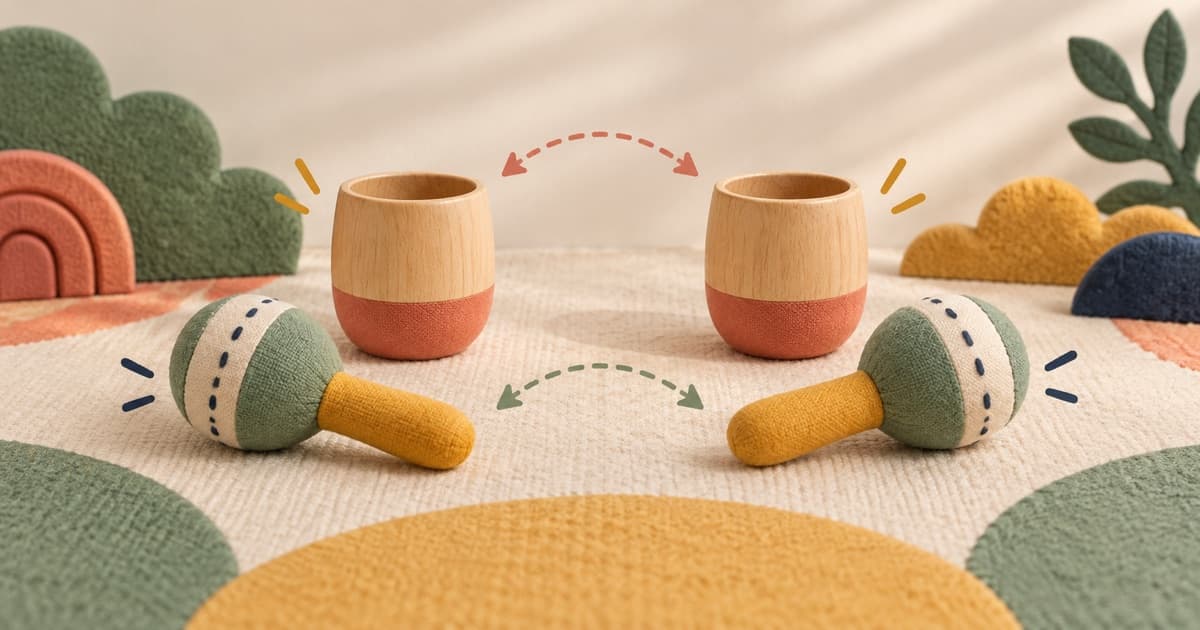
Imitation play can begin with you copying your baby's sound, facial movement, or safe action. Pause after one copy and watch for any answer: another sound, a look, a movement, or no reply. UNICEF and WHO caregiver guidance recommend copying sounds or gestures as a simple way to begin a conversation with a baby. UNICEF baby tips WHO/UNICEF caregiver manual
Key takeaways
- Copy one action at a time and keep it easy to see or hear.
- Alternate between copying your baby and offering a simple model to copy.
- Treat looking, smiling, moving, or turning away as valid responses.
- Never force a repeat or use imitation as a home developmental test.
Try a copy-and-pause exchange
| Baby says a sound | Copy it once, then wait quietly. |
|---|---|
| Baby taps a safe object | Tap your own object once and pause. |
| You wave slowly | Wait for any look or movement; do not demand a wave. |
| Baby turns away | Let the game end and return later. |
Imitation is broader than getting an exact match. A baby may watch closely today and try the movement another time. Use large, age-appropriate objects without loose parts, stay within reach, and follow your baby's comfort. The exchange is useful even when the response is different from the model. Kemenkes Buku KIA guidance
Observe, record, and ask
Observe what was copied, the setting, and how your baby responded. Record a repeated example only when it helps a caregiver or clinician understand the context. Ask a qualified clinician about persistent communication, hearing, vision, or movement concerns. The newsroom hub, gesture guide, and family-language guide add context. Tracking is not diagnosis. baby-development guides gestures before words family languages
Sources
Every figure in this guide traces to one of these sources.
- UNICEF — Parenting tips for the first two years
- WHO/UNICEF — Care for Child Development
- Kemenkes RI — Buku KIA 2024
General information, not medical advice. Talk to your pediatrician about your own child.

- Category
- Parenting · Child development
- Type
- Baby milestone & activity companion
- Compatibility
- iPhone (iOS) and Android
- Business model
- Free to start, for little ones 0–24 months
 Press ContactThe Learning Time team