
September 10, 2026
When do babies say first words? A normal range
Some babies say a clear word at nine months, others wait past fifteen, and both are on track. Here's what actually signals language is coming along.
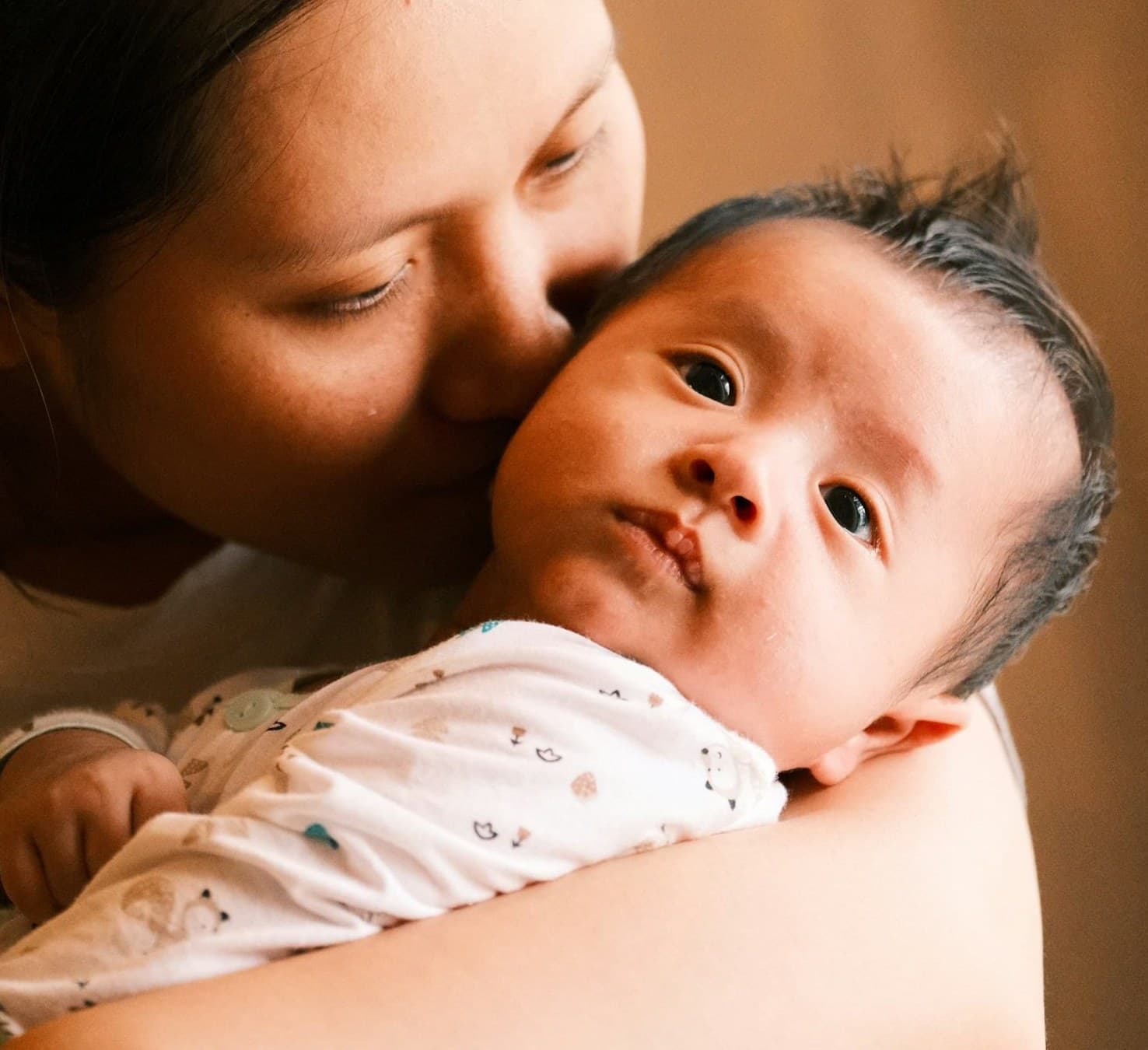
Most babies say a first recognisable word somewhere between 9 and 14 months. But the word itself is the least useful thing to watch for, and waiting on it is why so many parents feel behind when they are not.
The CDC's milestone for 18 months is worth reading carefully, because it is far more modest than most parents expect: "tries to say three or more words besides mama or dada." Three words. And trying counts.
Language starts long before the first word
By the time a baby says a word, they have already done most of the work. These are the signals that actually tell you language is coming, roughly in order:
- Turning toward your voice, and later toward their own name.
- Cooing, then babbling with consonants, the ba-ba-da-da stretch.
- Babbling with the rise and fall of real conversation, as if telling you something.
- Taking turns: they make a sound, you answer, they answer back.
- Gesture. Pointing, waving, holding something up to show you. Pointing to show, rather than to demand, is one of the strongest early language signals there is.
- Understanding before speaking. Following "give it to me" without a gesture is on the CDC's 18-month list, and comprehension always runs ahead of speech.
A baby who is doing these things is building language whether or not a clear word has arrived. A baby who says three words but does none of these is the one worth mentioning to a pediatrician.
If you speak more than one language at home
This is the part most milestone content skips entirely, and it matters to a great many families in Hong Kong and Indonesia.
Growing up with two languages does not cause a language delay. The research here is settled and consistent: when you count a bilingual baby's total vocabulary across both languages, they know about as many words as a monolingual peer, and they hit the same milestones on the same schedule, babbling, first word, and the 50-word mark included.
What confuses people is the counting. If you measure only one of the two languages, a bilingual toddler's vocabulary looks smaller, because their words are split across two systems. That is a measurement artefact, not a delay, and it is why a bilingual child should be assessed on both languages together rather than on whichever one the clinic happens to speak.
So mixing languages in a sentence is normal, and it is not confusion. Bilingualism itself does not cause language disorders. A bilingual child who does have a genuine language delay would show it in both languages, which is the thing worth checking.
When to raise it with your pediatrician
Bring it up if:
- No babbling with consonants by around 9 months, or no response to their own name.
- No gestures at all by 12 months. No pointing, no waving, no showing you things.
- No single words by 16 months, or fewer than three words being attempted by 18 months.
- Your child loses words or social skills they clearly had before. Regression warrants a call the same week, at any age.
- In a bilingual home, the concern shows up in both languages, not just the one used outside the house.
Hearing is the first thing a pediatrician will check, and it is worth doing early. Fluid behind the eardrum from repeated ear infections is common, easily missed, and one of the most treatable causes of slow expressive language.
What helps, and it is smaller than you think
Narrate what you are already doing. Leave a pause after you say something, as if they might answer, because eventually they will. Read the same book far past the point where you are bored with it, and name the thing your baby is already looking at rather than redirecting their attention to a thing you chose.
This is exactly why Emomo logs babbling and gesture, not only words. Tell it "waved bye today" or "said something that sounded like mama," and it keeps the whole shape of how your baby is starting to talk, in every language they are hearing, rather than only the headline moment.
Frequently asked questions
When do babies say their first word?
Most babies say a first recognisable word between 9 and 14 months. The CDC's 18-month milestone asks only that a child tries to say three or more words besides mama or dada, which is a far lower bar than most parents expect. Comprehension and gesture matter more than word count before 18 months.
Does raising a baby bilingual delay their speech?
No. Bilingual children reach the same language milestones on the same schedule as monolingual children, including babbling, first words, and a 50-word vocabulary. When their total vocabulary is counted across both languages, it is comparable to a monolingual peer's. Counting only one language makes it look smaller, which is a measurement artefact rather than a delay.
Is it normal for a toddler to mix two languages in one sentence?
Yes. Mixing languages within a sentence is a normal feature of bilingual development and is not a sign of confusion. Bilingualism does not cause language disorders. A bilingual child with a genuine language delay would show that delay in both languages, which is why assessment should cover both.
When should I worry my baby is not talking?
Speak to your pediatrician if there is no consonant babbling by around 9 months, no gestures such as pointing or waving by 12 months, no single words by 16 months, or fewer than three words being attempted by 18 months. Any loss of words a child previously used warrants a call the same week. A hearing check is usually the first step.
Sources
Every figure in this guide traces to one of these sources.
- CDC, “Milestones by 18 Months,” Learn the Signs. Act Early.
- Byers-Heinlein et al., “Sometimes larger, sometimes smaller: measuring vocabulary in monolingual and bilingual infants and toddlers,” First Language, 2024
- Bilingual Language Development in Infancy: What Can We Do to Support Bilingual Families?, Policy Insights from the Behavioral and Brain Sciences
General information, not medical advice. Talk to your pediatrician about your own child.

- Category
- Parenting · Child development
- Type
- Baby milestone & activity companion
- Compatibility
- iPhone (iOS) and Android
- Business model
- Free to start, for little ones 0–24 months
 Press ContactThe Learning Time team