
September 21, 2026
Cause-and-effect play with your baby
Let your baby repeat one safe action and notice what changes: press, shake, drop, or tip. Name the action and result, then pause. Keep it playful, not a test.
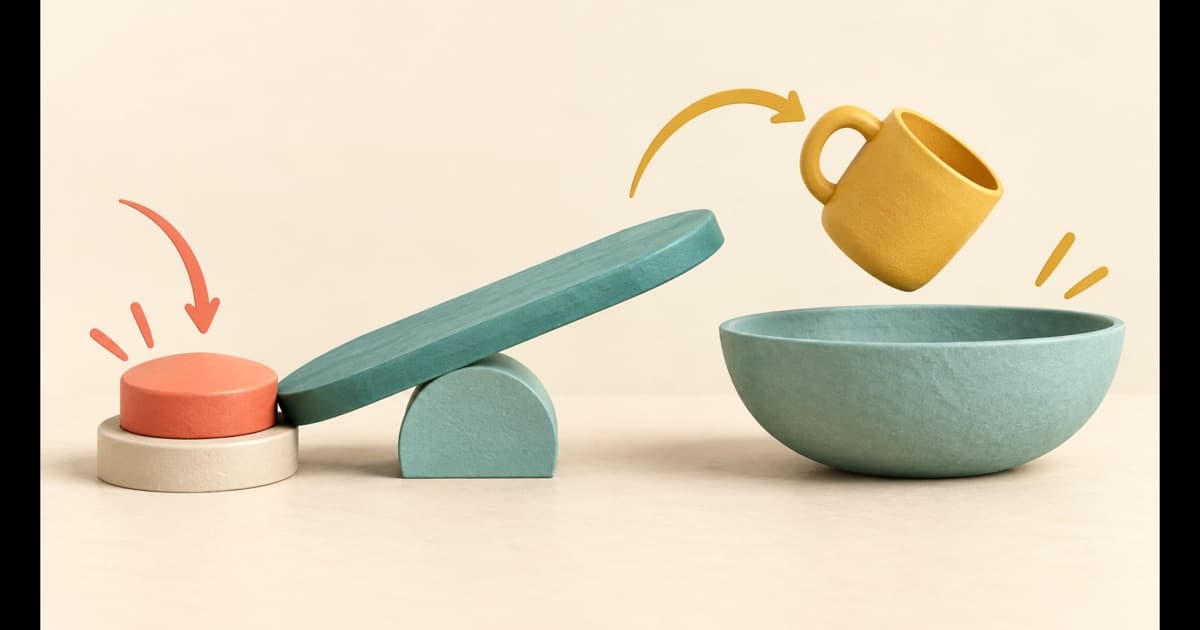
Cause-and-effect play gives a baby a clear connection between an action and a change: a cup falls into a bowl, a large button moves, or an intact shaker makes a sound. The AAP recommends opportunities for infants to notice that their actions have effects, while UNICEF offers simple on-and-off and rolling activities. AAP clinical report on play UNICEF activity examples
Key takeaways
- Choose one obvious action and one immediate result.
- Let your baby repeat it rather than quickly changing the game.
- Use short words such as press, fall, in, out, loud, or quiet.
- Keep batteries, cords, loose pieces, and breakable containers out of the play space.
Match the action to a safe setup
| Drop a large cup | It lands inside a wide bowl; use light, unbreakable pieces. |
|---|---|
| Press a broad button | A safe mechanical part moves; check that nothing can detach. |
| Tip a container | One large object slides out; stay close and avoid small fillers. |
| Bang two soft blocks | The sound changes; keep volume gentle and objects intact. |
The useful part is the baby's own action, not a flashy toy doing everything. Wait after naming the result so there is room to look, repeat, or stop. If an object is designed for an older child, has a damaged seam, or can fit in the mouth, choose another setup. AAP toy-selection guidance container-play guide
Observe, record, and ask
Observe the action your baby chose, what changed, and whether they repeated, paused, or looked to you. Record one example if it helps describe how your baby explores. Ask a qualified clinician about a persistent concern with movement, hearing, vision, interaction, or loss of a previously used skill. Explore the newsroom hub and imitation guide. Tracking is not diagnosis. baby-development guides imitation games
Sources
Every figure in this guide traces to one of these sources.
General information, not medical advice. Talk to your pediatrician about your own child.

- Category
- Parenting · Child development
- Type
- Baby milestone & activity companion
- Compatibility
- iPhone (iOS) and Android
- Business model
- Free to start, for little ones 0–24 months
 Press ContactThe Learning Time team