
September 21, 2026
Rolling a ball back and forth with baby
Roll one large, soft ball slowly across a clear floor and pause. Your baby may watch, touch, stop, push, or ignore it; each response can guide the next turn.
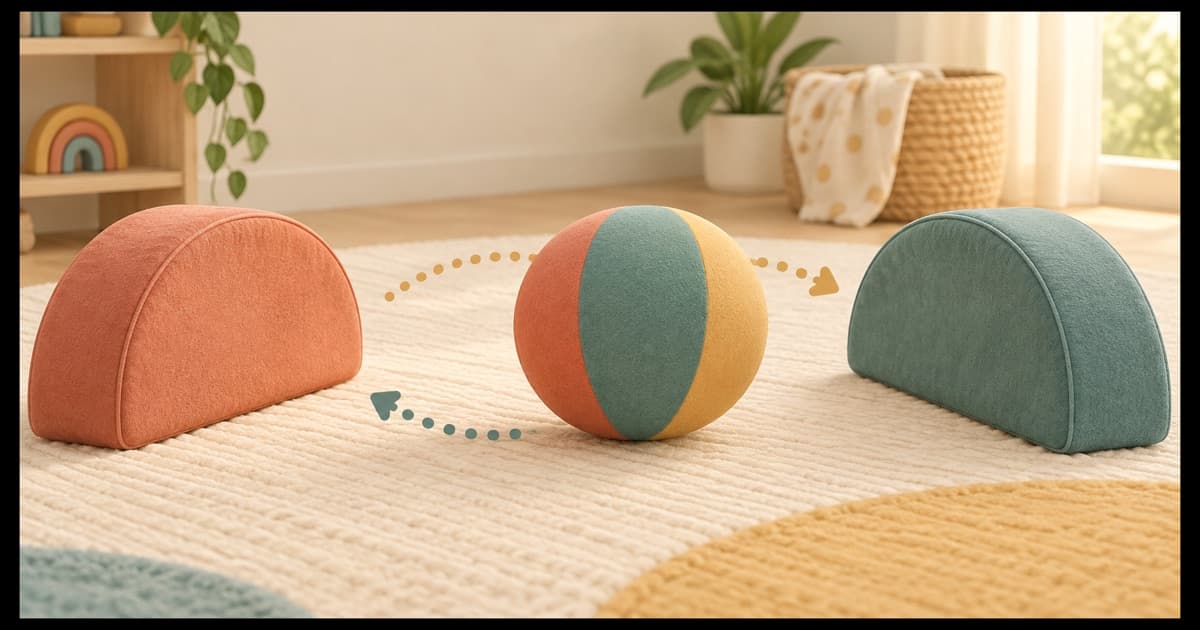
Rolling a ball can combine visual tracking, reaching, movement, and a simple social turn. Indonesian Ministry of Health guidance includes rolling a ball among stimulation ideas for babies, while UNICEF describes back-and-forth play as responding to a child's interest rather than controlling every move. Kemenkes stimulation guidance UNICEF back-and-forth play
Key takeaways
- Choose a large, light, soft ball that cannot fit in the mouth.
- Use a flat, clear floor away from stairs, furniture edges, pets, and hot drinks.
- Roll slowly from nearby and wait; touching or stopping the ball can be a turn.
- Match the game to the position your baby already uses comfortably.
Build one turn at a time
| Baby watches the ball | Stop it nearby and name ball or roll once. |
|---|---|
| Baby touches or traps it | Wait before gently rolling it away again. |
| Baby pushes in any direction | Treat that movement as the return turn. |
| Baby moves away or fusses | End the game and clear the ball from the path. |
The ball should invite movement, not pull your baby into a position they cannot control. Do not place it on a raised surface, roll it near stairs, or use a hard ball that can strike the face. A slow roll over a short distance keeps the action easy to follow. AAP active-play guidance safe exploration space
Observe, record, and ask
Observe whether your baby tracks, reaches, stops, pushes, or looks to you after the ball moves. Record the position and context only when it helps show a repeated pattern. Ask a qualified clinician about persistent concerns with vision, movement, balance, comfort, or interaction. Explore the newsroom hub and serve-and-return guide. Tracking is not diagnosis. baby-development guides serve-and-return play
Sources
Every figure in this guide traces to one of these sources.
- Kemenkes RI — Tugas perkembangan anak dan stimulasinya
- UNICEF — Playtime, anytime
- AAP — How active is your baby?
General information, not medical advice. Talk to your pediatrician about your own child.

- Category
- Parenting · Child development
- Type
- Baby milestone & activity companion
- Compatibility
- iPhone (iOS) and Android
- Business model
- Free to start, for little ones 0–24 months
 Press ContactThe Learning Time team