
September 20, 2026
Hide-and-find play with your baby
Hide one large safe object partly under a cloth, pause, and let your baby look or reach. Keep the game visible, supervised, and easy to stop.
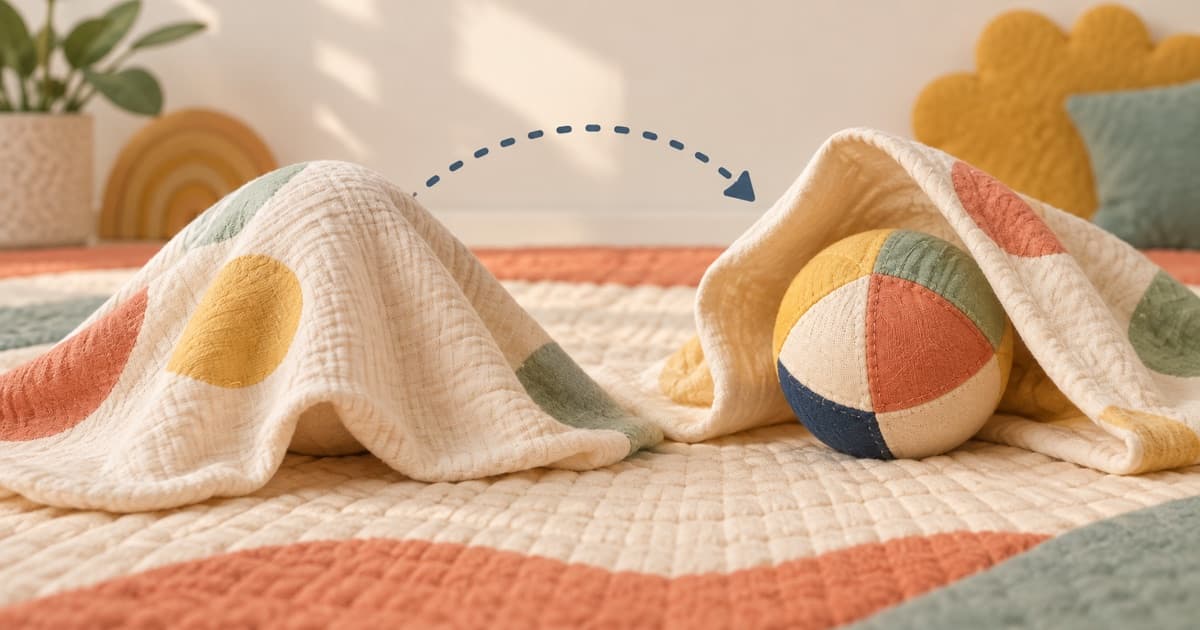
Hide-and-find play can be very small: let your baby see a large safe object, cover part of it with a light cloth, and pause. CDC lists looking for an object that drops out of sight among 9-month cognitive examples and suggests hiding a toy under a blanket. A milestone example describes a population pattern, not a deadline for one child. CDC 9-month guidance UNICEF hide-and-find idea
Key takeaways
- Begin with the object partly visible and make the hiding step obvious.
- Use one large, clean, age-appropriate object without loose parts.
- Keep the cloth away from the baby's face and stay within reach throughout.
- Help or reveal the object when interest fades; there is nothing to pass.
Make the game easier or harder gently
| Baby watches but does not reach | Leave more of the object visible. |
|---|---|
| Baby pulls the cloth | Name the action and reveal the object together. |
| Baby finds it quickly | Move it to one of two obvious positions. |
| Baby mouths the cloth or tires | Remove the cloth and end the game. |
WHO/UNICEF caregiver materials include hiding a favorite toy under a cloth or box as a play option for older babies. Follow your child's current interest and movement rather than using the game to prove object permanence. Avoid plastic bags, cords, heavy lids, small objects, or any setup that covers the face. Care for Child Development manual
Observe, record, and ask
Observe whether your baby tracks the object, searches, asks for help, or moves on. Record the context only if a pattern matters for a care conversation. Ask a qualified clinician about a persistent concern rather than repeating the game as a test. Browse the newsroom hub, age-guide context, and safe-object checklist. Tracking is not diagnosis. baby-development guides eight-month development guide safe play objects
Sources
Every figure in this guide traces to one of these sources.
- CDC — Milestones by 9 Months (2026)
- UNICEF — Parenting tips for the first two years
- WHO/UNICEF — Care for Child Development
General information, not medical advice. Talk to your pediatrician about your own child.

- Category
- Parenting · Child development
- Type
- Baby milestone & activity companion
- Compatibility
- iPhone (iOS) and Android
- Business model
- Free to start, for little ones 0–24 months
 Press ContactThe Learning Time team